Thursday, October 25, 2018

TSLP from epithelial and keratinocytes warn of bacteria

Epithelial and keratinocytes produce TSLP when infected.

TSLP stimulates langerhans cells and dendritic cells.
There are two isoforms of TSLP: a long and a short

The long form which appears with atopic dermatitis  (staph) simulates the myeloid dendritic cell to produce il-23 while the short form which appears with celiac disease (e.coli) stimulates Langerhans dendritic cells.

TSLP Thymic stromal lymphopoietin stimulates TH1 and Th17
https://ard.bmj.com/content/70/Suppl_2/A43.3

TSLP and il-13 Th2 cells
https://www.jacionline.org/article/S0091-6749(07)03504-X/fulltext

il-13 appears with bacterial infections that move inside of host cells.  Visible bacteria or parasites that stay outside of host cells trigger il-4 pathways

atopic dermatitis, TSLP, and il-13
https://www.jacionline.org/article/S0091-6749(07)03504-X/fulltext

staph triggers TLR2 producing TSLP
https://www.ncbi.nlm.nih.gov/pubmed/21050945

staph moves into skin cells and hide in vacuoles
https://www.ncbi.nlm.nih.gov/pmc/articles/PMC3417557/

TSLP activates myeloid dendritic cells which are responsible for triggering TH1 cytosol infection pathways
https://www.ncbi.nlm.nih.gov/pmc/articles/PMC3645262/

Th17 cells pop inner organelles

GM-csf is also involved with vacuole bacteria. GM-csf is secreted by macrophages, T cells, Nk cells, and mast cells.

GM-csf is stem cell stimulating: basophils, esoinophils, and neutrophils

GM-csf exposed Basophil's produce il-6 and trigger th17
https://www.nature.com/articles/srep41744

GM-csf exposed mDendritic make il-23
https://www.ncbi.nlm.nih.gov/pmc/articles/PMC4297527/


Thursday, October 18, 2018

Is autoimmune triggered paralysis caused by enteroviruses, Natural killer cells, and GM gangliosides?

Autoimmune cross-targeting hypothesis: two infections on one target tissue with one inside and one outside triggers autoimmunity.  Typically the outer larger infection is the one stopped and the attack on the internal viral infection is continued.

But what if when enteroviruses infect the ER involving the Natural Killer cells  the entroviruses are stopped first?

Here are my suspects (unproven)

Nodding disease: T. Brucei and polio live vaccine
Epilepsy: T gondii/t.cruzi/malaria and enterovirus
Absent seizure: mycoplasma polio or enterovirus
Guillain Barre: Campylobacter jejune and coxsackie
AFM/Hopkins: Staph and D68
peripheral neuropathy: e.coli and coxsackie

AFM and staph not just virus
https://www.ncbi.nlm.nih.gov/pmc/articles/PMC4536609/

Do autoimmune diseases involving enteroviruses involve the stopping of Natural killer cells? Instead stopping the attack on the large infection the immune system stops this pathway?

il-15 calls natural killer cells
https://www.ncbi.nlm.nih.gov/pmc/articles/PMC2191697/

Lower NK cells after seizures
https://www.ncbi.nlm.nih.gov/pubmed/18387608

https://www.sciencedirect.com/science/article/pii/S0014488608000356

https://www.researchgate.net/publication/20211933_Reduced_Natural_Killer_Cell_Activity_and_Okt4Okt8_Ratio_in_Epileptic_Patients

https://onlinelibrary.wiley.com/doi/abs/10.1002/hup.470080608

Lower NK in Guillain Barre
https://www.ncbi.nlm.nih.gov/pubmed/9619642

Peripheral neuropathy and low NK   aka "NK leukemia"
https://www.ncbi.nlm.nih.gov/pubmed/9710063
https://www.ncbi.nlm.nih.gov/pubmed/8414048
https://www.researchgate.net/publication/15601292_Natural_killer_cell_lymphoproliferative_disease_associated_with_neuropathy

How does the immune system stop NK cells?

Ganglioside antibodies are found in Guillain Barre and peripheral neuropathy so are they involved with stopping the NK cells?

guillain barre anti-ganglioside antibodies
https://www.ncbi.nlm.nih.gov/pmc/articles/PMC3422685/

peripheral neuropathy and anti-gangliosides
https://jnnp.bmj.com/content/75/12/1765

Gangliosides inhibit NK cells
https://www.ncbi.nlm.nih.gov/pubmed/2598999

ganglioside GM2 as a target for NK cells
https://onlinelibrary.wiley.com/doi/pdf/10.1002/jcla.1860010211

https://www.semanticscholar.org/paper/Ganglioside-GM2-on-the-K562-cell-line-is-recognized-Ando-Hoon/1437bc6c70867f826ce64591ffe2370aaf65b008

GM3 and NK
http://citeseerx.ist.psu.edu/viewdoc/download?doi=10.1.1.502.322&rep=rep1&type=pdf

Gangliosides are highly concentrated in the nervous system

diagram of glycolipids
http://www.brainkart.com/article/What-are-glycolipids-_27515/

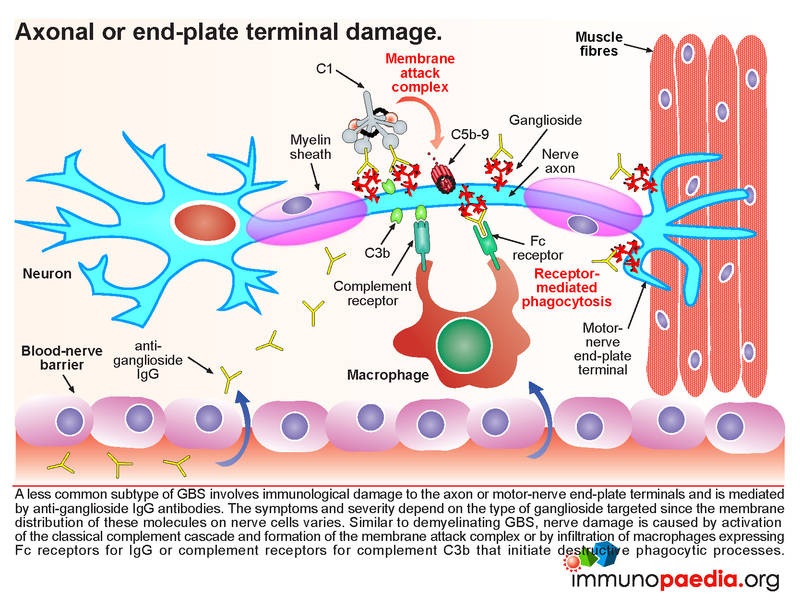
diagram of Guillain Barre with anti-gangliosides
http://www.immunopaedia.org.za/wp-content/uploads/2014/12/axonal-or-End-Plate-Terminal-Damage.jpg

so the reason for the formation of anti-ganglioside antibodies according to the Cross-targeting hypothesis is that the immune system can only deal with one infection at a time.  Enteroviruses which  infect the ER and trigger NK cells are shut down so that the immune system can focus on the bacterial infection. The problem is that the anti-ganglioside does more than block NK from seeing GM2. Thus the paralysis.

AFM (acute flaccid myelitis) and anti-ganglioside
https://www.ncbi.nlm.nih.gov/pmc/articles/PMC5976313/
https://www.ncbi.nlm.nih.gov/pubmed/29028962

Monday, October 8, 2018

Combining the T gammadelta hypothesis with the autoimmune cross-targeting hypothesis.

The T gamma delta hypothesis was that Tgd function like B cells to produce gamma delta antibodies against lipid antigens which get confused with the IgG1 of B cells.    What is important is the idea that these are completely different immune system "couples". Instead of T and B it is NKT and T gamma delta.

Surmised cytokines


In order to create IgG4 the B cell must switch T cell partners and see a different cytokine. There is confusion and mixing. Tfh making il-4 for the outer antigens of E.coli while at the same time Tc would be making il-10? 


Possible? 

Can we show that these are Gamma delta antibodies and not IgG1?


Just for fun : IgG gamma delta mycobacteria (cytosol lipid infection)
                      IgG gamma delta Bacteria ( visible lipid  infection )
                      IgG gamma delta virus (lipid coat)
I just made this up....right now they are all lumped together as IgG1

3 different gamma delta elements in the T gamma delta receptor
https://www.ncbi.nlm.nih.gov/pubmed/7511639
                   

Gram positive Bacteria lipid A held by cd1.c  and cd1.b (monocytes and macrophages)
https://www.ncbi.nlm.nih.gov/pubmed/19948070

cd1.b on macrophages (cdl.b induced by il-4)
https://www.ncbi.nlm.nih.gov/pubmed/9175583

So cdl.c and cdl.b  both end up producing the IgG gamma delta B ?

HIV and cd1.a and langerhans
https://www.ncbi.nlm.nih.gov/pubmed/17442711

Friday, October 5, 2018

Correction on Cytokines and B cells becoming plasma cells and producing antibodies


I had il-4 as always with il-21 inducing B Cells but that didn't make sense because the B cell needed to know who it's T cell parter in order to make the correct antibody. Further the production of  IgG4 with a partner switch supports the Autoimmune Cross-targeting Hypothesis.


Possible? Are the cytokines matched up correctly?

Note that insulin creates IgG1, growth hormone creates IgA dimer, and IGF-1 creates IgE. 

Does that mean that the IgG4 goes against the hormone in control first? anti-insulin, anti-GH, anti-IGF-1?  unless it is a vacuole bacteria or fungal? Then it is IgG4 to neutrophils ? "ANCA" ?

Autoimmune Cross-targeting: Two infections on one tissue triggering the immune system. One inside while one is outside the tissue's cells 

Wednesday, October 3, 2018

Two types of CTL: CTL-Fas with cytosol viral infections and CTL-TCR with nuclear or mitochondrial infections.

Hypothesis: A cytosolic virus triggers the TH pathway with il-2 primed CTL which uses Fas to destroy cells.  This can be seen in Type one diabetes where the cytosolic flu virus can trigger the disease,  The nuclear virus HBV triggers the the Tc pathway where il-21 primes the CTL to kill using it's TCR which looks into the MHC1 of cells. This Tc pathway also involves TH17 cells to pop the nuclear membrane with il-26 and then il-17F to call CTL.

Type 1 diabetes, CTL and fas
https://www.ncbi.nlm.nih.gov/pubmed/15466911
http://diabetes.diabetesjournals.org/content/51/5/1391

Flu virus, fas CTL
https://www.ncbi.nlm.nih.gov/pmc/articles/PMC1143766/

CTL and fas
https://www.ncbi.nlm.nih.gov/pmc/articles/PMC3088981/

Fas binding induces apoptosis

Granzyme A and apoptosis CTL induced death
http://jcb.rupress.org/content/167/3/457

CTL killer with granzyme B
https://retrovirology.biomedcentral.com/articles/10.1186/1742-4690-9-S2-P13

Platelets mediate CTL in HBV liver damage
https://www.ncbi.nlm.nih.gov/pmc/articles/PMC2908083/1

platelets contain TGF-b1
https://www.ncbi.nlm.nih.gov/pmc/articles/PMC3271718/

TLR9 and HBV
https://www.ncbi.nlm.nih.gov/pubmed/24942353

TLR9 /TGF-b1 pathways and blood
https://www.ncbi.nlm.nih.gov/pubmed/28356164

Th17 and HBV induced liver damage
https://www.ncbi.nlm.nih.gov/m/pubmed/28731149/

TBF-b1and Th producing il-21
https://journals.plos.org/plosone/article?id=10.1371/journal.pone.0064612

il-21 and CTL TCR
https://www.ncbi.nlm.nih.gov/pmc/articles/PMC3042849/

il-21 and granzyme B
https://www.sciencedirect.com/science/article/pii/S0022202X17313106

il-2 increases all 3 granzyme A,B, and C
http://www.jimmunol.org/content/175/12/8003


unless il-5 triggers the monomer version of IgA the hormones appear to dictate

Tuesday, September 4, 2018

Eosinophils hypothesis


Appears that there are 5 types of eosinophils

Complement Eosinophils : C1q,  C3b/C4b, iC3b receptors : Bacteria : granulation

GM-CSF Eosinophils : Low affinity cd32 FcgammaR2 (IgG receptor) : vacuole Bacteria : granulation

il-5 Eosinophils :  cd89 Fc alpha R1(IgA receptor) : Parasites: granulation

il-3 Eosinophils : Fc epsilon R1 (IgE receptor) high affinity:
                              Fc epsilon low affinity receptor

 Viral Eosinophils that contain RNases

il-4 seems involved with antigens outside of the house cell while il-13 seems involved with antigens of the cytosol (visible parasite vs. one that moves into the cytosol of the host cell.


Do the Macrophages clean up the IgE antibodies?
https://www.ncbi.nlm.nih.gov/pmc/articles/PMC1421858/


Do Platelets? They appear to have storage pools if IgE
https://www.sciencedirect.com/science/article/pii/S0091674997702306

Hypothesis: Platelets clean up IgE